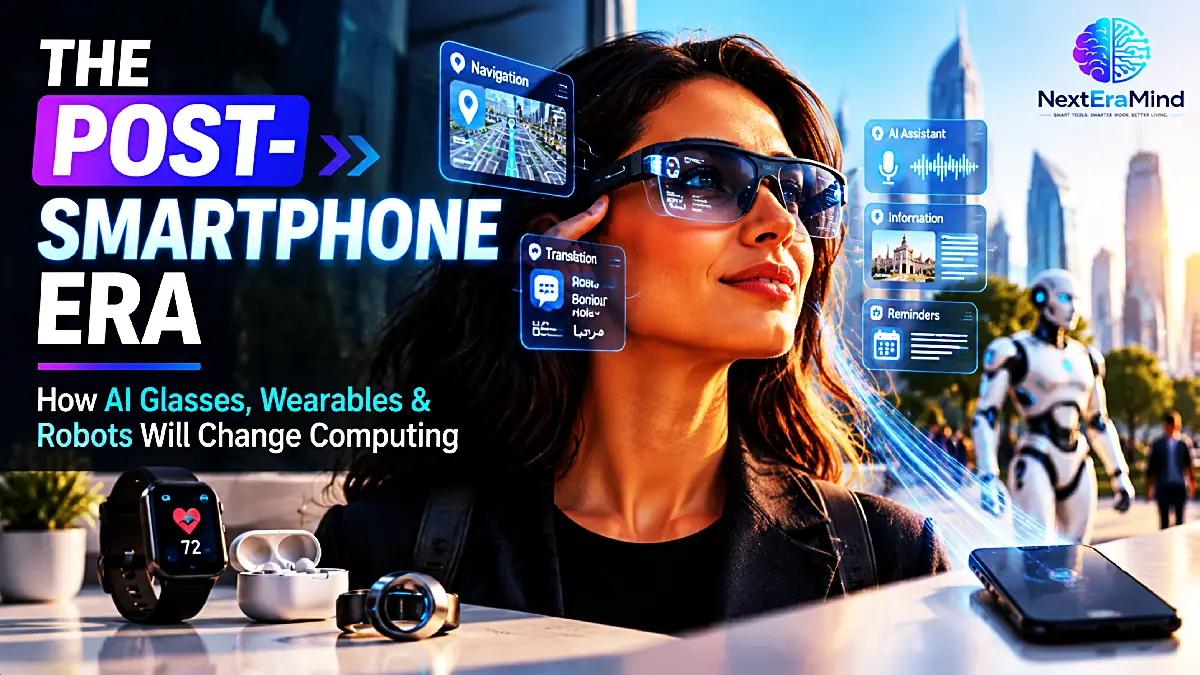
For more than a decade, the smartphone has been the center of our digital lives. We use it to communicate, search the web, navigate cities, take photos, manage work, consume entertainment, and interact with AI.
But computing is beginning to move beyond the traditional screen.
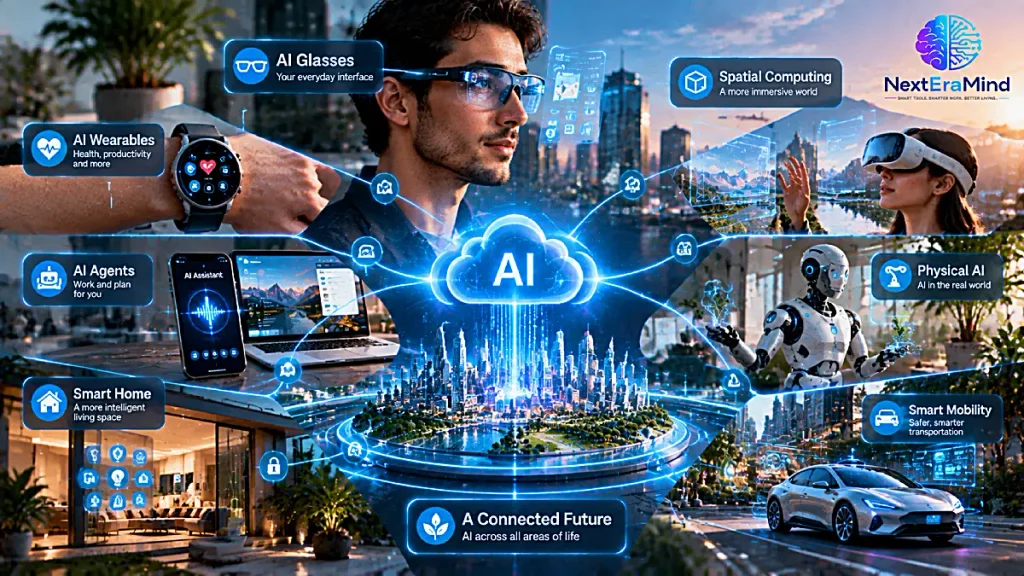
In 2026, AI glasses, intelligent wearables, spatial computing, AI agents, and physical AI are becoming increasingly important parts of the technology landscape. The goal is not necessarily to eliminate the smartphone overnight. Instead, the next generation of computing may distribute its functions across a collection of devices that understand context and interact with us more naturally.
This emerging post-smartphone era could change not only the devices we use, but also how we interact with technology.
AI glasses are already attracting significant attention. IDC reported that the global smart-glasses category grew 167% year over year in the first quarter of 2026, reaching approximately 2.25 million units shipped during the quarter. IDC forecasts around 13.6 million smart glasses shipments for the full year 2026.
At the same time, companies including Google, Samsung and Meta are developing increasingly sophisticated AI-powered eyewear and wearable experiences.
So, what could computing look like after the smartphone?
What Is the Post-Smartphone Era?
The post-smartphone era refers to a potential future in which the smartphone is no longer the primary interface through which people access digital services and artificial intelligence.
Importantly, this does not necessarily mean smartphones will disappear.
Instead, smartphones could become one component of a larger ecosystem that includes:
- AI glasses
- Smartwatches
- AI earbuds
- Wearable assistants
- Augmented-reality devices
- AI agents
- Smart home systems
- Robots
- Other connected devices
The biggest change may be the interface.
Today, you usually have to take your phone out, unlock it, open an app, type something, and read the response.
Future AI systems could make that interaction much more natural.
You could ask a question aloud, receive directions through your glasses, translate a conversation in real time, capture information from your surroundings, or ask an AI assistant to perform a task without constantly looking at a screen.
Google, for example, is developing Android XR experiences that bring Gemini-powered assistance to intelligent eyewear, including features such as directions, messaging and photography. Google describes both audio eyewear and display-equipped glasses as part of its approach to wearable computing.
The result is a shift from screen-based computing to contextual computing.
1. AI Glasses Could Become the Next Major Computing Interface
Among all emerging technologies, AI glasses may be one of the clearest examples of the post-smartphone direction.
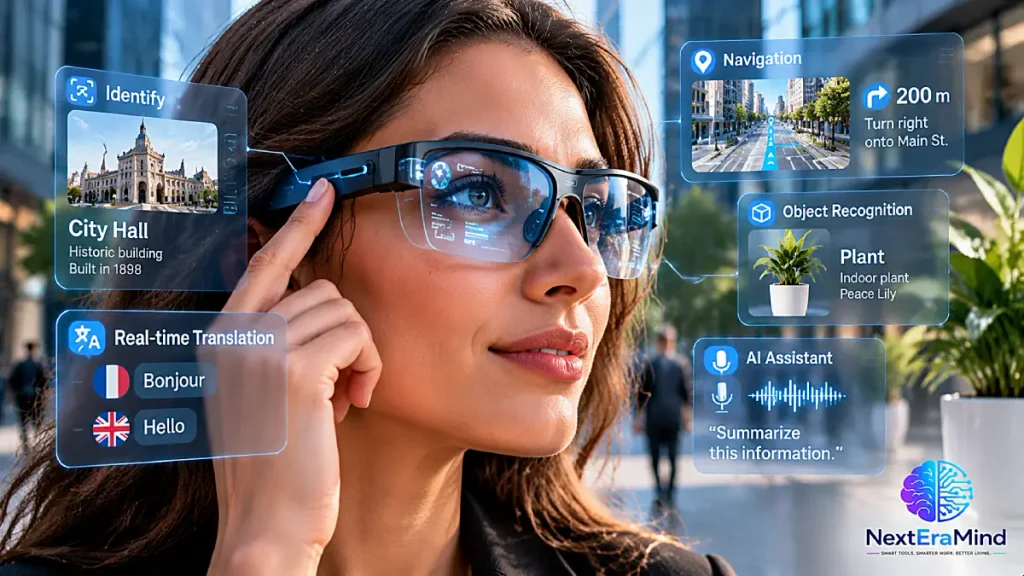
Unlike traditional smartphones, glasses can remain with you while your hands are occupied.
They can potentially:
- Hear your questions
- Capture photos and video
- Provide spoken answers
- Translate conversations
- Identify objects
- Give navigation instructions
- Summarize information
- Help you remember things
- Connect with other devices
- Provide contextual information about your surroundings
Google’s 2026 Android XR announcements show how companies are trying to integrate AI directly into eyewear rather than requiring users to constantly interact with a phone.
Samsung is pursuing a similar direction. Its intelligent eyewear is designed to provide contextual AI assistance through cameras, microphones and speakers while remaining connected to the broader Galaxy ecosystem.
Meta is also expanding its AI glasses strategy. In September 2026, Meta announced new AI glasses products and described its vision of glasses becoming a hands-free interface for personal AI.
The significance of these developments is not simply that glasses are becoming “smart.”
It is that AI is becoming ambient.
Instead of going to technology, technology increasingly comes with you.
2. Why AI Glasses Could Be Different From Smartphones
Smartphones are extremely powerful, but they require deliberate interaction.
You need to look at the screen.
AI glasses can potentially reduce that friction.
Imagine walking through a foreign city.
Instead of:
- Taking out your phone
- Opening a translation app
- Pointing your camera at a sign
- Reading the translation
- Putting your phone away
You could potentially look at the sign and ask your glasses:
“What does this mean?”
The answer could be delivered through audio or, with display-equipped glasses, directly within your field of view.
The same principle could apply to navigation.
Rather than constantly checking a map, an AI assistant could provide short, contextual instructions when you need them.
This is one reason the industry is exploring context-aware computing.
The device does not simply respond to a command. It can potentially understand more about the user’s environment and situation.
That could make computing feel less like operating a machine and more like interacting with an assistant.
3. AI Wearables Could Make Computing More Personal
AI glasses are only one part of the emerging wearable-AI ecosystem.
Other devices could include:
- AI earbuds
- Smartwatches
- Wearable cameras
- AI pendants
- Smart rings
- Health-focused wearables
- Future neural or biometric interfaces
Each device could specialize in a different type of interaction.
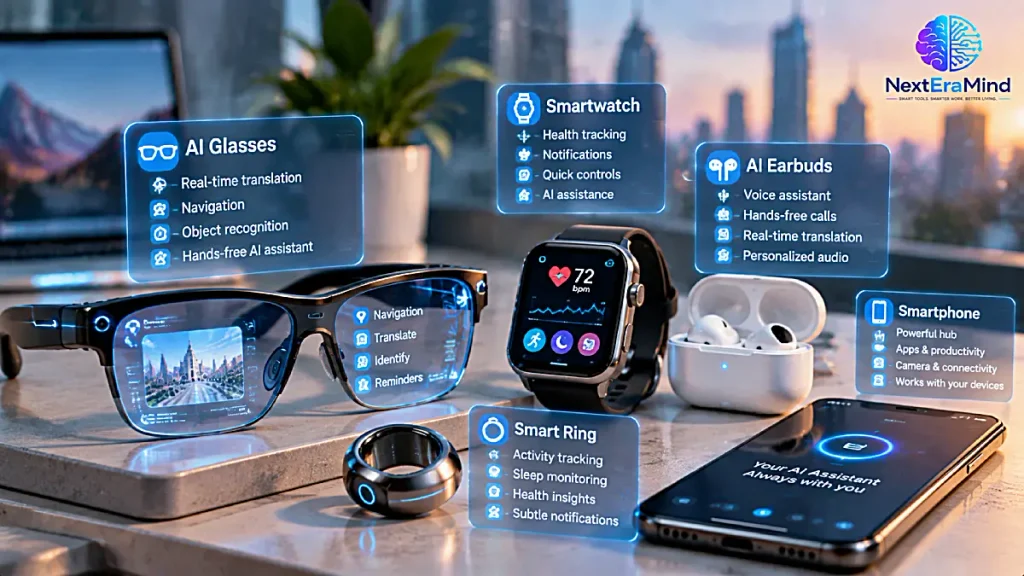
For example:
| Device | Potential role |
|---|---|
| AI glasses | Vision, navigation and contextual information |
| AI earbuds | Voice interaction and audio assistance |
| Smartwatch | Notifications, health and quick controls |
| Smart ring | Sensors and passive data collection |
| AI pendant | Voice-based personal assistance |
| Smartphone | Complex tasks, apps and traditional computing |
| Robot | Physical-world actions |
Rather than having one device perform everything, the future could involve distributed computing.
Your AI assistant could move between devices depending on what you are doing.
At home, it might interact through a smart speaker.
Outside, it might communicate through your glasses.
During exercise, it could work through your watch and earbuds.
At work, it might operate through your computer.
This would make the AI assistant less tied to a particular device.
4. The Smartphone May Become a Hub Instead of the Main Interface
One of the most interesting possibilities is that smartphones may not actually disappear.
They could simply become less visible.
Instead of being the device you constantly look at, the smartphone could increasingly function as a powerful hub connecting your wearables, applications, cloud services and AI assistants.
Samsung, for example, describes its intelligent eyewear as a companion to smartphones and other Galaxy devices rather than simply a replacement for them.
This approach makes sense.
Smartphones already have:
- Powerful processors
- Large batteries
- High-quality cameras
- Cellular connectivity
- Storage
- App ecosystems
- Large displays
Glasses cannot easily match all of those capabilities because they must remain lightweight and comfortable.
That creates an opportunity for split computing.
The glasses handle the interaction.
The phone or cloud handles more demanding processing.
The user experiences the result without necessarily thinking about which device is doing the work.
5. Spatial Computing Will Connect Digital Information to the Physical World
Another important part of the post-smartphone era is spatial computing.
Traditional computing largely happens on flat screens.
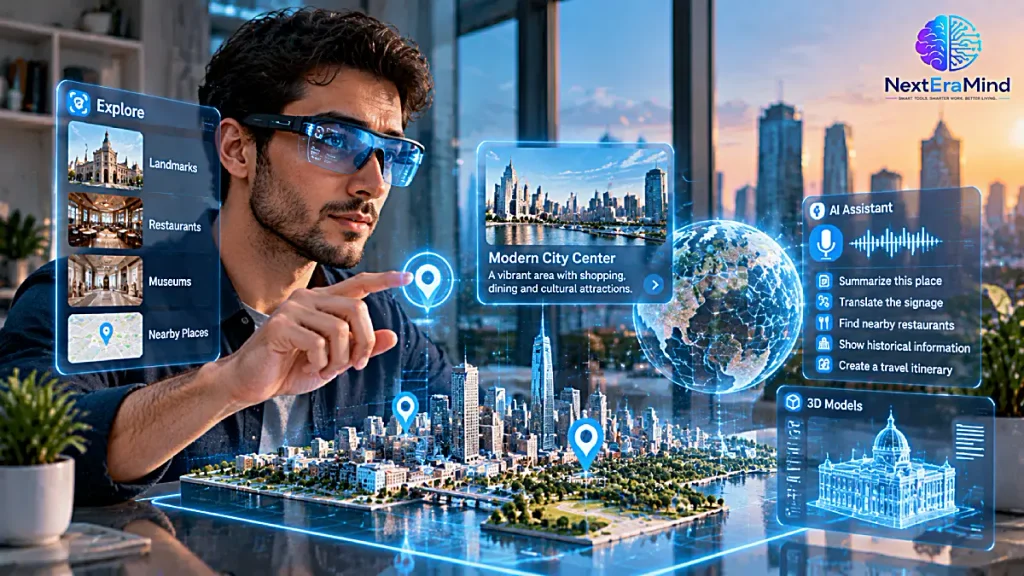
Spatial computing attempts to understand and interact with the physical environment around you.
Imagine walking into a room and seeing digital information connected to physical objects.
A machine could display maintenance instructions.
A tourist could see historical information about a building.
A student could interact with a three-dimensional model of the human heart.
An engineer could examine a virtual representation of a machine while standing next to the real one.
AI makes this more powerful because it can interpret what the user sees and generate useful information in context.
Instead of simply displaying a digital object, an AI system could understand the environment and respond to questions about it.
This could eventually connect computer vision, AI assistants, augmented reality and robotics into a single ecosystem.
6. Physical AI Could Take AI Beyond Screens
The next major step may be even more significant.
AI is increasingly moving from digital environments into the physical world.
This concept is often called Physical AI.
Instead of an AI model only generating text, images or code, Physical AI enables systems to perceive their surroundings and interact with the real world through machines.
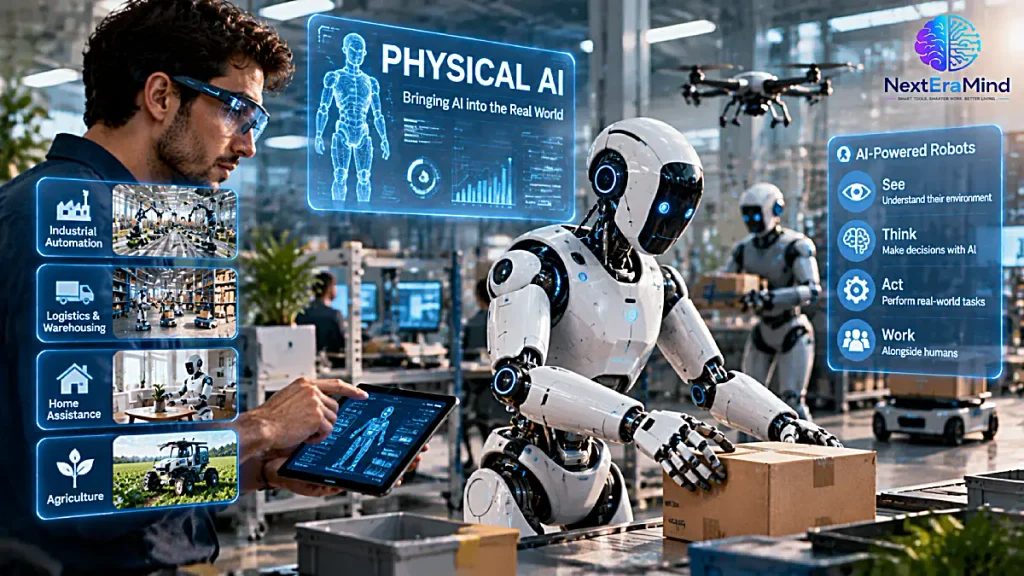
Examples include:
- Robots
- Drones
- Autonomous vehicles
- Industrial machines
- Smart equipment
- Warehouse systems
- Agricultural robots
Gartner included Physical AI among its top strategic technology trends for 2026, describing it as AI that brings intelligence into the physical world through robots, drones and smart equipment.
This represents a major transition.
Generative AI asks:
“What can AI create?”
Physical AI asks:
“What can AI do in the real world?”
7. Humanoid Robots Are Part of the Same Bigger Shift
Humanoid robots have become one of the most visible symbols of future technology.
The idea is straightforward: create machines capable of operating in environments designed for humans.
A humanoid robot could potentially:
- Walk through buildings
- Manipulate objects
- Carry items
- Use tools
- Perform repetitive tasks
- Assist in industrial environments
- Eventually help with selected household activities
However, it is important to separate the current state of the technology from futuristic demonstrations.
Humanoid robots remain an emerging technology, and large-scale deployment faces significant technical and economic challenges.
Gartner predicts that fewer than 20 companies will successfully scale humanoid robots into production for manufacturing and supply-chain applications by 2028. It also expects many projects to remain at pilot or experimental stages during that period.
That does not mean humanoid robots are irrelevant.
It means their development is likely to be gradual.
The most practical applications may initially involve controlled environments where robots perform specific tasks rather than acting as fully autonomous general-purpose household assistants.
8. AI Agents Could Connect All These Technologies
AI glasses and robots become much more interesting when combined with AI agents.
An AI chatbot primarily answers questions.
An AI agent can potentially go further by planning and executing a sequence of actions.
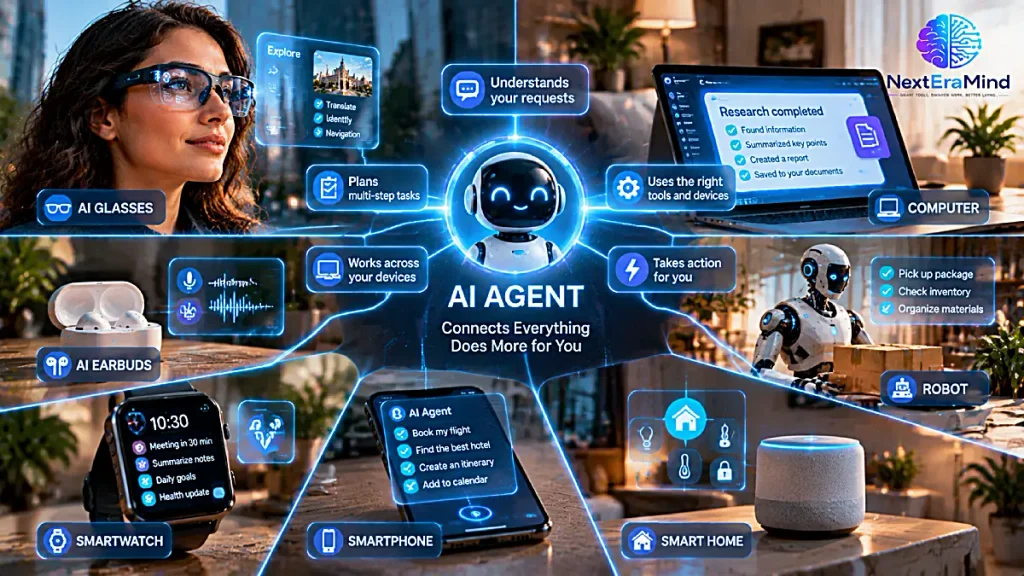
For example, imagine saying:
“Remind me about this meeting tomorrow and prepare a summary of the documents I need.”
A future AI agent could potentially:
- Understand the request.
- Identify the relevant meeting.
- Find the necessary documents.
- Summarize them.
- Create a reminder.
- Present the information through your preferred device.
The interface could be your glasses.
The processing could happen partly on your phone and partly in the cloud.
The agent could interact with other software.
And if a physical action were necessary, a robot or smart device could potentially perform it.
This is where the different pieces of future technology begin to converge.
9. Privacy Could Become One of the Biggest Challenges
The post-smartphone era will not be only about convenience.
It will also raise serious questions about privacy.
AI glasses can have cameras and microphones close to the user at all times.
That creates a fundamental question:
What happens when wearable technology can constantly see and hear the world around you?
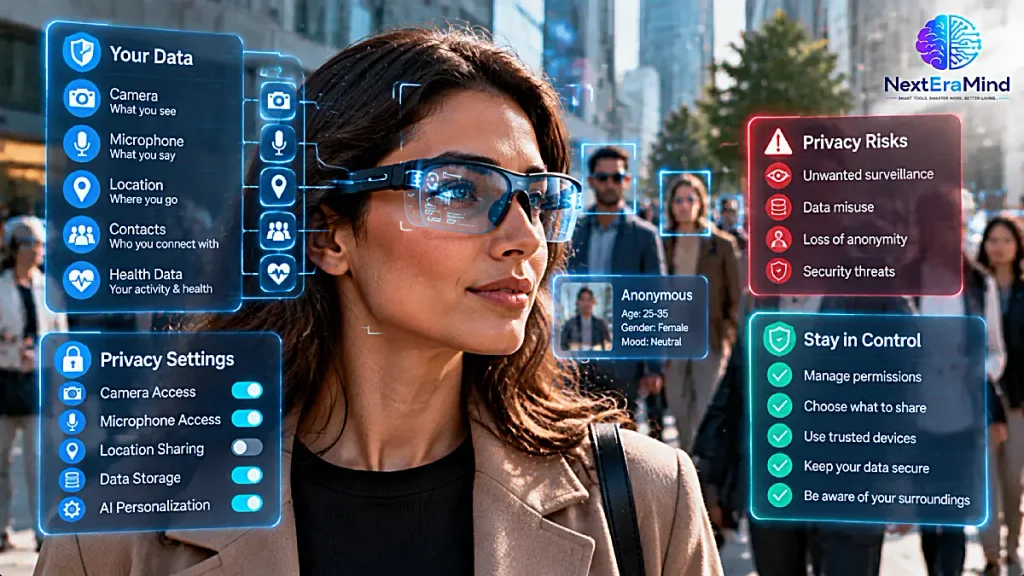
Privacy concerns around AI glasses have already intensified in 2026. Reuters reported growing public and regulatory concerns about recording, data handling and consent surrounding AI-powered wearables.
The UK’s Information Commissioner’s Office has also highlighted privacy, surveillance and consent concerns surrounding smart glasses and other AI-enabled wearable devices.
The challenge extends beyond the person wearing the device.
Consider a restaurant.
A meeting room.
A classroom.
A hospital.
A public street.
People around the device may not know whether they are being recorded or how their information is being processed.
That means future wearable technology will need more than good hardware.
It will require clear privacy controls, visible recording indicators, strong security and meaningful user consent.
10. On-Device AI Could Become Increasingly Important
One possible solution is processing more information locally.
Today, powerful AI models often require cloud infrastructure.
But sending personal information to the cloud introduces additional privacy and latency considerations.
As AI chips become more efficient, more AI processing can potentially happen directly on devices.
Meta, for example, has described its Private Processing architecture for AI glasses, designed to protect personal information when more demanding AI workloads need to be processed in the cloud.
The long-term direction could involve a combination of:
On-device AI + secure cloud AI + personal AI agents
Simple tasks could happen locally.
More complex tasks could use secure cloud infrastructure.
The AI assistant could determine where processing should occur based on factors such as performance, privacy and connectivity.
11. What Could Replace the Smartphone?
The more likely answer may be:
Nothing replaces it completely.
Instead, the smartphone could become less central.
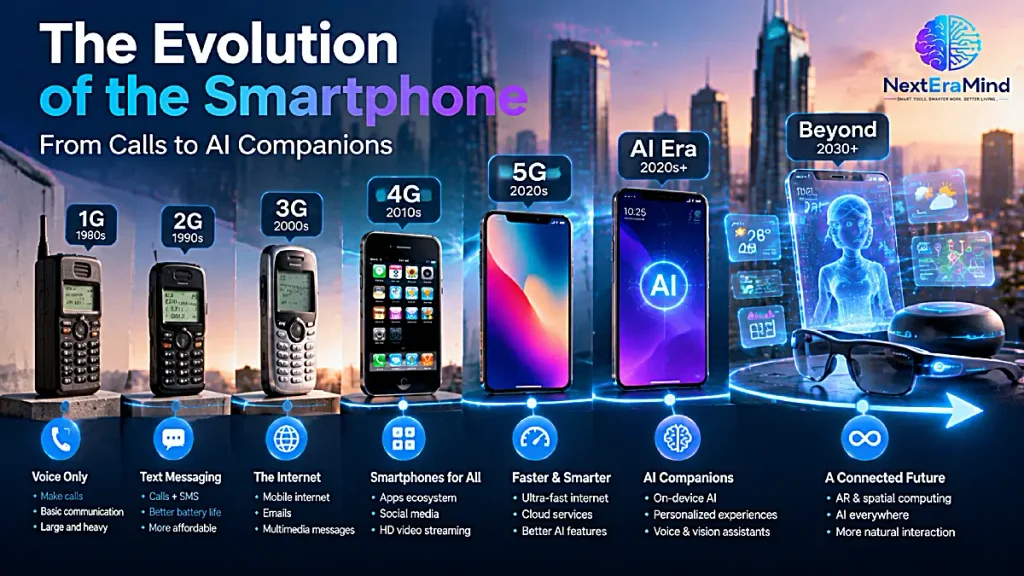
Consider how computing might be distributed around a person in the future:
AI glasses
Your primary interface for visual information, navigation and contextual assistance.
AI earbuds
Your primary voice interface.
Smartwatch
Your quick-access device for notifications, health information and controls.
Smartphone
Your powerful computing hub for complex tasks.
AI agent
The software layer connecting everything.
Robots
The physical layer capable of acting in the real world.
This is fundamentally different from today’s smartphone-centric model.
The device becomes less important.
The AI layer becomes more important.
12. What Could Computing Look Like by 2030?
Predicting technology is difficult, so it is better to think in terms of possibilities rather than certainties.
By 2030, we could see a computing environment where:
- AI assistants understand much more personal context.
- Glasses provide increasingly useful hands-free assistance.
- Wearable devices communicate with each other automatically.
- AI agents perform more multi-step digital tasks.
- Spatial computing becomes more practical in professional applications.
- Robots become more common in controlled industrial environments.
- More AI processing happens directly on devices.
- Smartphones remain important but become less central to everyday interactions.
The biggest change may not be a single revolutionary gadget.
It could be the integration of many technologies.
Instead of asking:
“What is the next smartphone?”
we may eventually ask:
“What is the next computing ecosystem?”
13. The Biggest Shift: From Apps to AI
There is another important change happening beneath the hardware.
For years, we interacted with technology through apps.
Want directions?
Open a maps app.
Want to translate something?
Open a translation app.
Want to create an image?
Open an image-generation app.
Want to summarize a document?
Open an AI tool.
AI agents could gradually change this model.
Instead of deciding which app to use, you could simply describe what you want.
The AI could determine which services or tools are necessary.
This creates a transition from:
Apps → Assistants → Agents
That could become one of the most important changes in computing.
14. What the Post-Smartphone Era Means for Everyday Life
The impact could extend far beyond technology enthusiasts.
For students
AI glasses could potentially provide translations, explanations and contextual learning assistance.
For travelers
Wearable AI could provide navigation and language assistance without requiring constant phone interaction.
For professionals
AI assistants could summarize meetings, retrieve information and provide contextual reminders.
For people with disabilities
Hands-free and visual AI systems could potentially provide useful accessibility features.
For creators
Wearable cameras and AI could simplify first-person content creation and real-time editing.
For businesses
Physical AI and robotics could automate selected tasks in manufacturing, logistics and other controlled environments.
The technology will not affect everyone in the same way.
Its usefulness will depend on factors such as cost, reliability, privacy, accessibility and how well these devices fit into everyday life.
15. The Future May Be Less About Screens
The smartphone revolution taught us to think of computing as something we hold in our hands.
The next phase could make computing something that surrounds us.
AI could become available through:
- Glasses
- Earbuds
- Watches
- Cars
- Homes
- Computers
- Robots
- Other connected devices
Instead of constantly looking at a screen, we may increasingly communicate with technology through voice, vision, gestures and natural language.
That does not mean screens will disappear.
Large displays will remain useful for tasks that require concentration, precision and detailed information.
But the screen may no longer be the default interface for everything.
The Challenges Ahead
The post-smartphone era is promising, but several challenges remain.
Privacy
Devices that can see and hear their surroundings require strong safeguards.
Battery life
Small wearable devices have limited space for batteries and processors.
Comfort
A device worn all day must be lightweight and comfortable.
AI accuracy
An assistant that misunderstands its environment can create serious problems.
Cost
Advanced hardware may initially remain expensive.
Social acceptance
People may not be comfortable around cameras and microphones embedded in everyday objects.
Security
As AI devices become more connected and autonomous, protecting personal data and accounts becomes increasingly important.
Reliability
For many applications, people will expect AI to work consistently rather than occasionally producing impressive demonstrations.
These challenges will help determine which technologies move from exciting prototypes into everyday products.
So, Are Smartphones Really Going Away?
Probably not anytime soon.
The more realistic scenario is that smartphones evolve from being the main interface into being one component of a much larger personal computing ecosystem.
AI glasses may handle contextual interactions.
Earbuds may handle conversations.
Watches may handle quick information.
Computers may remain essential for intensive work.
Robots may handle selected physical tasks.
And AI agents could connect all of these experiences.
The smartphone could still sit at the center of that ecosystem—but increasingly in the background.
Final Thoughts: Welcome to the Post-Smartphone Era
The post-smartphone era is unlikely to arrive on a single launch day.
It will probably emerge gradually.
AI glasses will become more capable.
Wearables will become smarter.
AI agents will become more autonomous.
Spatial computing will mature.
Physical AI will bring intelligence into robots and machines.
And smartphones will continue evolving alongside them.
The most important change may therefore not be the disappearance of the smartphone.
It may be the disappearance of the idea that one device has to be the center of our digital lives.
The future of computing could be more distributed, more contextual and increasingly powered by AI.
Instead of constantly asking technology what it can do, we may eventually expect it to understand what we need—and help us without getting in the way.
The post-smartphone era is not simply about replacing a device.
It is about changing the way humans interact with computing.
Frequently Asked Questions
What is the post-smartphone era?
The post-smartphone era describes a potential future in which smartphones are no longer the primary interface for digital computing. AI glasses, wearables, AI agents, spatial computing and other connected devices could take over some functions traditionally handled by smartphones.
Will smartphones disappear?
There is no certainty that smartphones will disappear. A more likely possibility is that smartphones remain important while becoming part of a broader ecosystem of AI-powered devices.
What are AI glasses?
AI glasses are wearable devices that combine traditional eyewear with technologies such as cameras, microphones, speakers, AI assistants and, in some cases, displays.
What can AI glasses do?
Depending on the product, AI glasses can provide features such as voice assistance, photography, messaging, navigation, translation and contextual information. Capabilities vary significantly between devices.
What is Physical AI?
Physical AI refers to AI systems that operate in or interact with the physical world. Examples include robots, drones and intelligent machines. Gartner included Physical AI among its strategic technology trends for 2026.
Will humanoid robots become common?
Humanoid robots are still an emerging technology. Some companies are developing them for industrial and other applications, but significant technical, cost and deployment challenges remain. Gartner expects many humanoid-robot projects to remain at pilot or experimental stages in the near term.
What is the future of computing?
The future of computing is likely to involve a combination of AI assistants, cloud and on-device computing, wearables, spatial interfaces, smartphones, computers and physical AI rather than a single replacement for today’s devices.
Conclusion
The next major computing revolution may not produce one device that replaces the smartphone.
Instead, it could create an ecosystem where AI glasses, wearables, smartphones, computers, AI agents and robots work together.
The result could be a world where computing becomes less visible but more deeply integrated into everyday life.
The smartphone changed how we access information.
AI could change how we interact with information altogether.