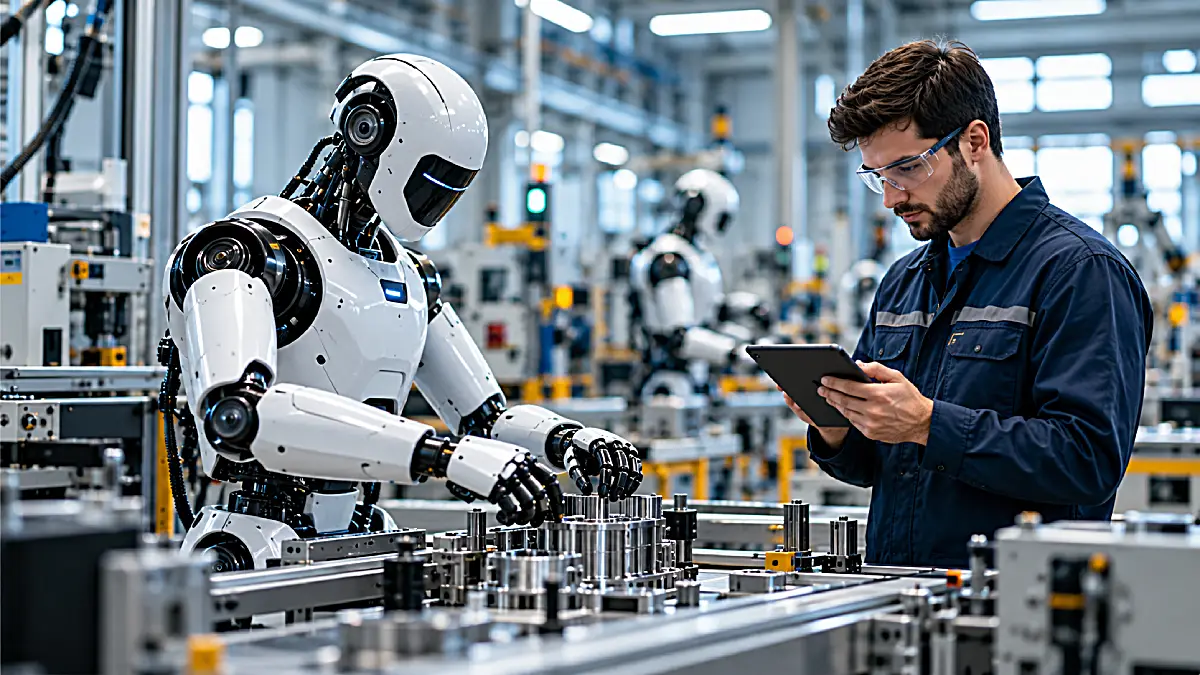
Picture a warehouse robot moving boxes across the other side of a bustling building. Now picture it encountering a surprise problem, understanding that its normal path is blocked and finding another way to get around it.
That kind of real world decision making is one reason why physical AI is getting so much attention.
Physical AI is different from the AI tools that generate text or answer questions on a screen. Physical AI links intelligence to machines that can see their surroundings, move and interact with objects. The technology is under exploration and implementation in fields like manufacturing, logistics and agriculture with very different capabilities from system to system.
For a broader look at how robots and other emerging technologies may change the way we interact with devices, read our guide to the post-smartphone era
So how does Physical AI work then? And how far are we from robots that can perform mundane tasks without constant supervision by humans? Let’s see what technology can do today, where it still struggles, and what may come next.
Table of Contents
- What Is Physical AI?
- How Does Physical AI Work?
- Physical AI vs. Traditional AI
- Real-World Applications of Physical AI
- Humanoid Robots and the Rise of Intelligent Machines
- The Main Challenges of Physical AI
- Will Physical AI Change the Future of Work?
- What to Expect From Physical AI Beyond 2026
- Frequently Asked Questions
1. What Is Physical AI?
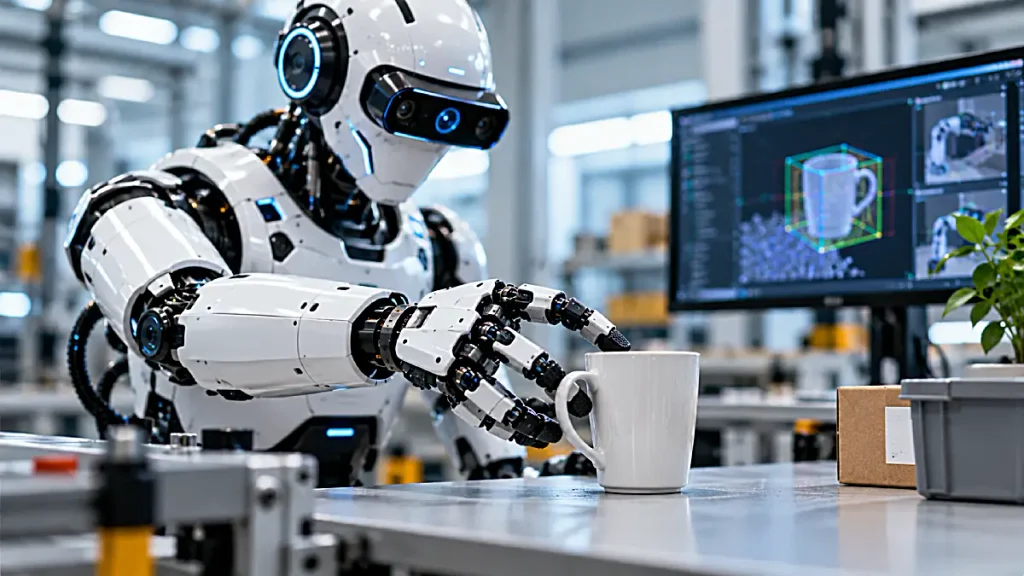
Think about the difference between asking an AI assistant how to pick up a glass and having a robot actually pick one up. The first task involves generating an answer. The second requires the machine to locate the glass, judge its position, move its arm, grip it carefully, and adjust if something goes wrong.
That is the basic idea behind physical AI.
Physical AI refers to AI systems that operate through physical machines, including robots, autonomous vehicles, and other intelligent equipment. They combine AI models with sensors, cameras, and control systems to interpret their surroundings and carry out actions.
The difficult part is getting everything to work together. A robot might recognize an object correctly but still fail to grasp it securely. Understanding an environment and acting successfully within it are two different challenges.
Physical AI is closely related to embodied AI, a term that emphasizes intelligence operating through a physical body or interactive environment. The two terms overlap, although their usage can vary across research and industry.
Unlike software that operates entirely in a digital environment, physical AI must account for real-world conditions. Objects can move, surfaces can be slippery, lighting can change, and unexpected obstacles can appear.
2. How Does Physical AI Work?
Physical AI combines several technologies to help machines understand their environment and carry out physical tasks.
Sensors and cameras
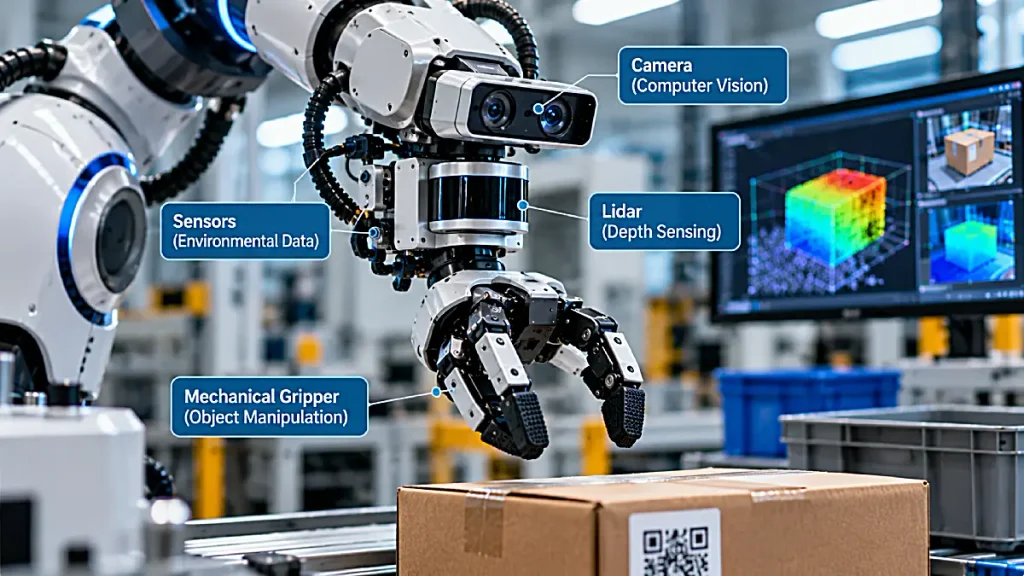
Cameras, depth sensors, lidar, microphones, and sometimes touch sensors collect information about the surrounding environment. This information helps a robot identify objects, estimate distances, detect movement, and understand its position.
AI models
AI models process incoming data to recognize objects, interpret instructions, predict possible outcomes, and understand what is happening around the machine. Depending on the application, the system may combine computer vision, language models, spatial reasoning, and specialized control models.
Planning and decision-making
The system uses the available information to select an appropriate action. For example, a warehouse robot may need to find a clear route to a package, while a robotic arm must determine how to grasp an object without dropping or damaging it.
Robotic hardware and movement
Motors, actuators, wheels, robotic arms, and grippers translate decisions into physical movement. The robot must continuously adjust its actions using feedback from its sensors.
Feedback and learning
Physical AI systems can compare their actions with the intended results and adapt their behavior. Some improve through training in simulations, while others use carefully controlled real-world experience. Not every robot learns autonomously during operation; many rely on models trained and tested before deployment.
In simple terms, physical AI follows a continuous process: perceive, interpret, plan, act, and evaluate.
3. Physical AI vs. Traditional AI
Physical AI builds on artificial intelligence techniques but applies them to machines that must interact with the real world.
| Feature | Traditional digital AI | Physical AI |
| Main purpose | Analyze information or generate digital content | Perceive and act in the physical world |
| Inputs | Text, images, audio, and digital data | Sensor data, camera feeds, and environmental information |
| Outputs | Text, predictions, images, or recommendations | Physical movements, machine actions, and control signals |
| Environment | Primarily digital | Physical and often unpredictable |
| Examples | ChatGPT, image generators, recommendation systems | Humanoid robots, warehouse robots, autonomous machines |
A generative AI assistant can explain how to pick up a cup, for example. A physical AI robot must also locate the cup, position its hand, apply the right amount of force, and lift it without spilling its contents.
If you’re interested in AI that helps with digital tasks rather than physical ones, explore our guide to the best AI productivity tools in 2026
Physical AI can itself use generative AI and other advanced models. The distinction is not that these technologies are unrelated; it is that physical AI connects intelligence to real-world perception and action.
4. Real-World Applications of Physical AI
Physical AI is developing across several industries. Some applications are already established in controlled environments, while others remain experimental or are being tested for wider deployment.
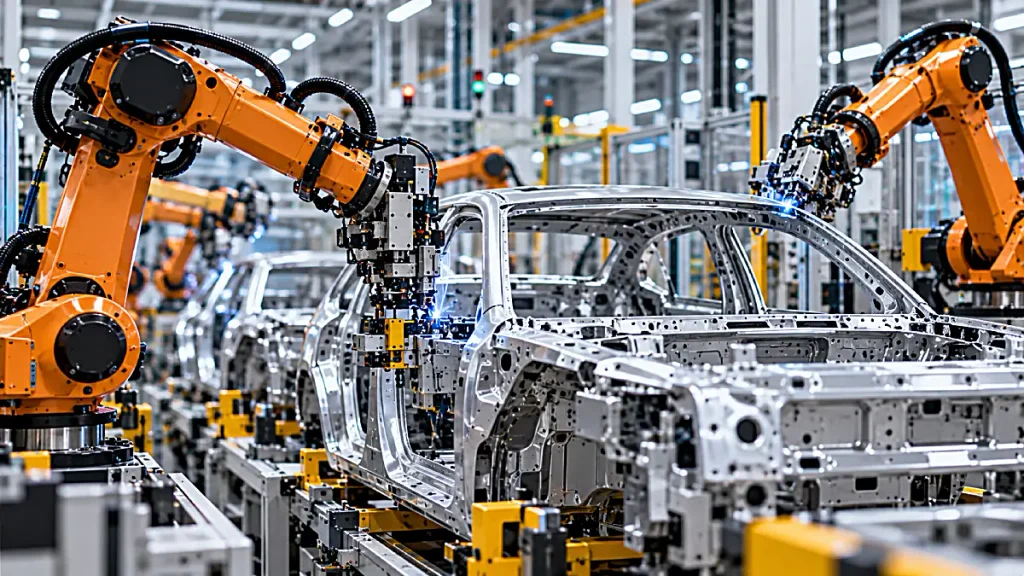
Manufacturing: More flexible production lines
Factories have used robots for years, but AI can help some systems respond to changes rather than repeat exactly the same movement every time. For example, a vision-enabled inspection system can identify certain product defects, while an appropriately equipped robotic arm may handle objects in different positions.
These capabilities still depend on the task, the quality of the system, and the factory environment. A robot designed for one assembly operation cannot automatically perform every other job on the production line.
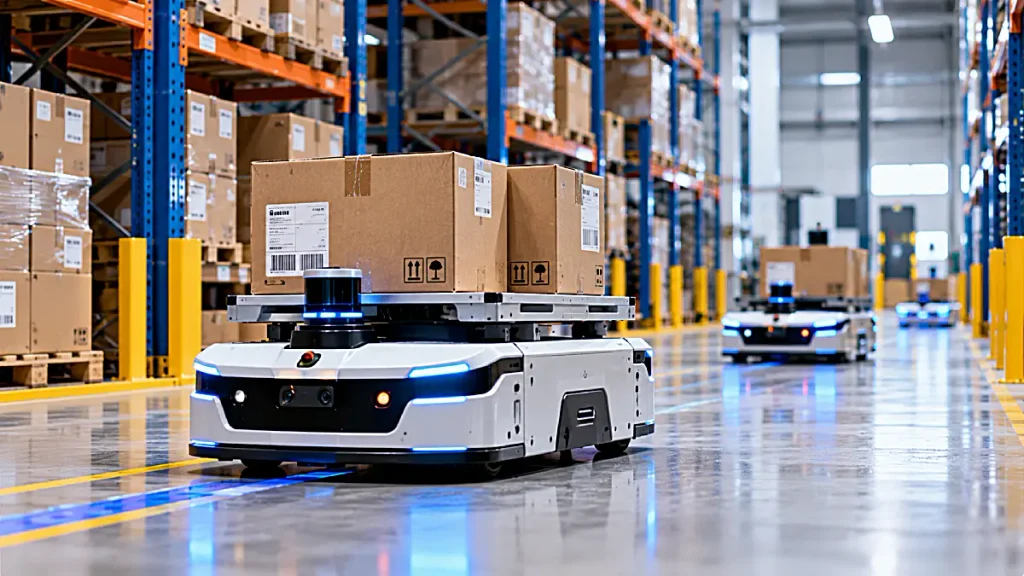
Warehousing: Moving goods more efficiently
A warehouse is a useful place to see the value of physical AI. Mobile robots can transport goods through designated routes, while more advanced systems are being developed to pick and sort a wider range of packages.
Moving a standard container is relatively straightforward compared with picking up an unfamiliar object from a cluttered shelf. This is one reason robotic transport has become more practical than general-purpose robotic handling in many environments.
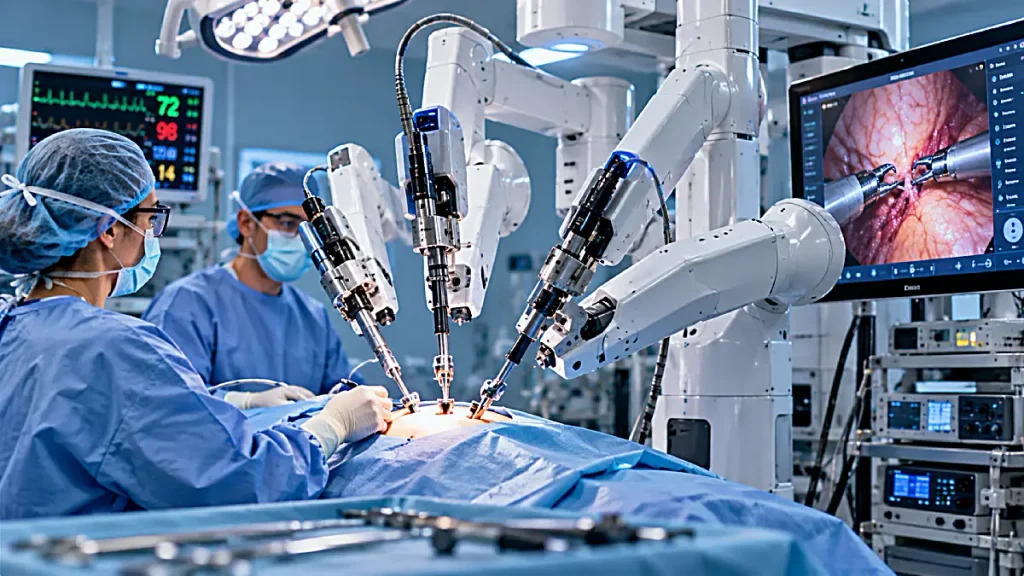
Healthcare: Assistance, not independent medical judgment
Robotic technology already supports certain surgical procedures, rehabilitation, and laboratory tasks. AI may further support these systems by improving perception, movement planning, and assistance with repetitive procedures.
These applications require strict safety controls, clinical validation, and qualified human oversight. A robot assisting a clinician is not the same as a machine independently deciding how to treat a patient.
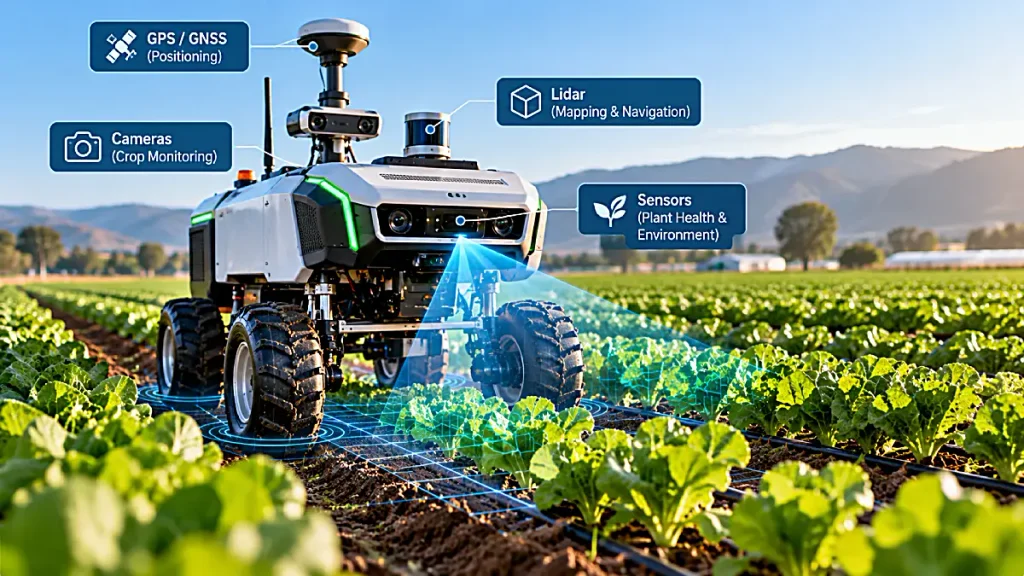
Agriculture: Working in unpredictable conditions
Fields present a different challenge. Lighting, weather, soil, and crop conditions can change throughout the day. AI-equipped machines can support crop monitoring and selected precision-farming tasks, including identifying weeds or inspecting plant health.
These systems may help farmers use resources more precisely, but their performance depends on the equipment and operating conditions. It would be misleading to suggest that farms can already automate every planting or harvesting task.
Homes and everyday environments
Domestic robots are another potential application. Beyond familiar vacuum-cleaning robots, researchers and companies are developing machines that can manipulate household objects, carry items, and assist with simple physical tasks.
However, a home is a much less predictable environment than a factory. Objects vary in shape, rooms change, and people and pets move unexpectedly. General-purpose home robots still face significant challenges before they can reliably handle a wide range of everyday chores.
5. Humanoid Robots and the Rise of Intelligent Machines
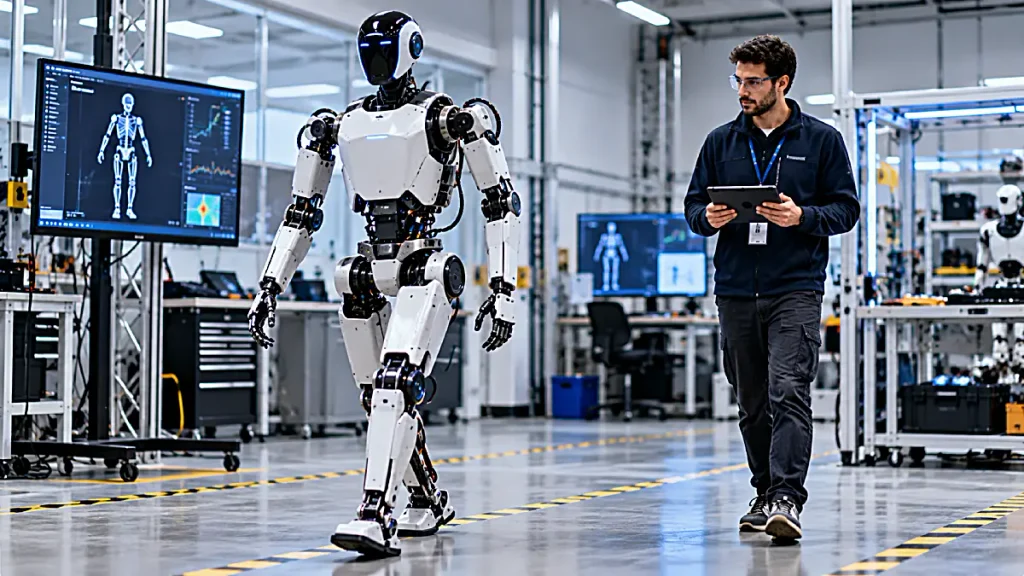
Humanoid robots are among the most visible examples of physical AI. Their human-like body structure, including arms, hands, and legs, is designed to help them interact with environments originally built for people.
In principle, a humanoid robot could move between workstations, pick up objects, use certain tools, and perform multiple tasks without requiring a completely redesigned workplace.
However, having a human-like shape does not automatically make a robot intelligent or capable. Successful operation depends on its ability to perceive objects, maintain balance, coordinate movements, and respond to unexpected situations.
Several major challenges remain:
- Dexterity: Handling fragile, small, or irregular objects requires precise control.
- Mobility: Walking and balancing on uneven or cluttered surfaces remain difficult.
- Reliability: Robots must perform tasks consistently over long periods.
- Cost: Hardware, maintenance, training, and integration can make deployment expensive.
- Safety: Machines must operate around people without creating unacceptable risks.
The most useful humanoid robots will not necessarily be those that look the most human. Their value will depend on whether they can perform specific tasks safely, consistently, and economically.
6. The Main Challenges of Physical AI
Although physical AI has considerable potential, translating intelligence into reliable physical action is difficult.
Safety and reliability
A mistake in a digital response can often be corrected by generating another answer. A mistake by a moving robot could damage equipment, destroy products, or injure someone.
Developers must test systems across different conditions and introduce safeguards, emergency stops, restricted operating zones, and appropriate human supervision.
Real-world complexity
Robots operate in environments filled with variations. Lighting changes, objects become obstructed, surfaces are slippery, and unexpected obstacles appear.
A model that performs well in a controlled demonstration may struggle when deployed in a different environment. Testing in realistic conditions is therefore essential before a robot is trusted with more complex tasks.
Training and data
Physical AI requires information about movement, object interaction, spatial relationships, and real-world conditions. Collecting high-quality robotic training data can be expensive and time-consuming.
Simulation helps developers train and test systems before deployment, but simulated environments cannot perfectly reproduce every physical condition.
Cost and infrastructure
Businesses must consider more than the purchase price of a robot. They also need to account for integration, software, maintenance, staff training, safety procedures, and potential downtime.
For some tasks, a conventional industrial robot or a simpler automated machine may still be more practical than an advanced AI-powered system.
Privacy and accountability
Robots equipped with cameras and microphones may collect information about workers, customers, patients, or household members.
Organizations must consider data protection, access controls, retention policies, and accountability when a system makes an incorrect decision or causes harm.
7. Will Physical AI Change the Future of Work?
Physical AI could change the way people work by automating selected tasks and enabling machines to operate in environments that previously required more direct human involvement.
In manufacturing, robots may take on repetitive assembly and inspection tasks. In logistics, they may move goods and support inventory management. In agriculture, they may assist with monitoring and precision operations.
These developments could improve productivity and reduce exposure to dangerous or physically demanding work.
Physical robots are only one part of this shift. Discover how AI productivity tools can improve everyday workflows and help people spend less time on repetitive tasks.
However, the effect on employment is unlikely to be identical across industries. Some tasks may be automated, some jobs may change, and new roles may emerge in robot maintenance, system integration, safety, and AI operations.
The outcome will depend on how quickly the technology improves, how affordable it becomes, and how organizations choose to implement it.
For workers, useful skills may include technical troubleshooting, operating automated systems, interpreting data, and collaborating with robotic equipment. For businesses, the challenge will be to identify where automation genuinely improves results rather than adopting technology simply because it is new.
Physical AI is therefore better understood as a potential transformation of tasks and workflows, rather than a simple prediction that robots will replace all human workers.
8. What to Expect From Physical AI Beyond 2026
The next stage of physical AI will likely focus on making robots more adaptable, reliable, and useful outside highly controlled environments.
Several developments are worth watching.
More capable general-purpose robots. Research is advancing toward robots that can perform a wider range of tasks instead of being designed for one narrowly defined activity. Reliable general-purpose performance remains an important challenge.
Better integration of AI models and robotics. Advances in vision-language-action models may help robots connect visual information and natural-language instructions to physical actions.
Improved simulation and training. More realistic simulations and larger collections of robotic training data could reduce the time and cost needed to develop new capabilities.
More practical industrial deployments. Businesses are likely to evaluate robots according to measurable outcomes such as reliability, operating cost, safety, and the number of tasks completed successfully.
Gradual expansion into everyday settings. Robots may become more common in warehouses, commercial facilities, and selected home applications. The pace of adoption will depend on whether they can operate safely and deliver enough value to justify their cost.
The most important question is not whether robots will become more advanced. It is whether they can perform useful physical tasks reliably enough to make a meaningful difference in the real world.
9. Frequently Asked Questions About Physical AI
What is physical AI in simple terms?
Physical AI is artificial intelligence that enables robots and other machines to understand their surroundings and perform actions in the physical world. It combines AI software with sensors, computing systems, and physical hardware.
What is the difference between physical AI and generative AI?
Generative AI creates content such as text, images, audio, and code. Physical AI enables machines to perceive their environment and take physical actions. A physical AI robot may use generative AI as part of its capabilities, but it also needs systems for movement, control, and safety.
Are humanoid robots an example of physical AI?
Yes. Humanoid robots can use physical AI to perceive their surroundings, understand instructions, manipulate objects, and move through environments. Their actual capabilities vary significantly by model.
Is physical AI already being used today?
Yes. AI-enabled robotic systems are used in areas such as manufacturing, logistics, agriculture, and selected healthcare applications. However, not every industrial robot uses advanced AI, and many more general-purpose applications are still being developed or tested.
Will physical AI replace human workers?
Physical AI may automate some tasks and change others, but its impact will vary by industry. Some jobs may be reduced or redesigned, while demand may grow for people who develop, operate, maintain, and supervise robotic systems.
What are the biggest limitations of physical AI?
Key limitations include safety, reliability, high deployment costs, difficulty handling unpredictable environments, training-data requirements, and the challenge of performing unfamiliar tasks consistently.
Conclusion: Physical AI Is Bringing Intelligence Into the Real World
Physical AI is an important development because it connects digital intelligence with physical action. From industrial robots and autonomous warehouse machines to emerging humanoid systems, it is creating new possibilities for automation.
But impressive demonstrations are only part of the story. A robot that completes a task once is not necessarily ready to perform it safely and reliably throughout an entire working day.
That is the challenge developers and businesses must solve. As AI models, sensors, and robotic hardware improve, physical AI could become increasingly useful across manufacturing, transportation, agriculture, healthcare, and everyday life.
For now, the most sensible way to view physical AI is as an evolving technology with substantial potential—and real engineering challenges still to overcome.
Curious about other emerging technologies? Explore our article on the post-smartphone era and the future of AI glasses, wearables, and robots.
Explore more articles in our Future Tech category for insights into the innovations shaping tomorrow.